
Latest news
-

New grants for the team
Both Helena Malmström and Torsten Günther received research grants! Congratulations! Alvastra – archaeogenetics, archaeology and cultural interactions Research Project grant from VR Humanities and Social Sciences, 2018-21PI Helena Malmström The archaeological record show two major cultures, the so called Funnel Beaker (TRB) farmers and Pitted Ware (PWC) hunter-gatherers, which coexisted for a long time in Stone Age…
-
Ancient DNA pushes human emergence back
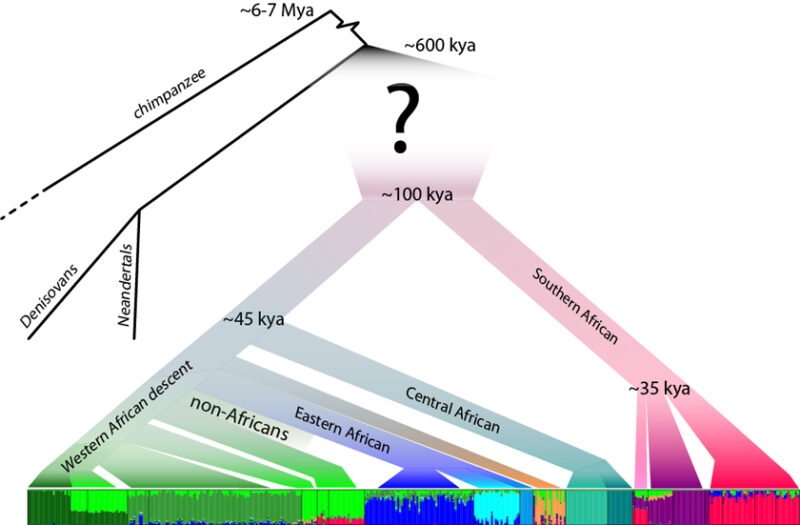
The complete genomes of southern African human remains reveals that modern humans emerged more than 300,000 years ago A genomic analysis of ancient human remains from KwaZulu-Natal (South Africa) revealed that southern Africa has an important role to play in writing the history of humankind. A research team from Uppsala University, Sweden, the Universities of…
-

Southern African ancient genomes estimate modern human divergence to 350,000 to 260,000 years ago
Carina Schlebusch with her team just published analyses of the ancient remains from South Africans in Science today. You can find more information about this fascinating study in our post: Ancient DNA pushes human emergence back. Anatomically modern humans evolved in Africa, but pinpointing when has been difficult. Schlebusch et al. sequenced three ancient African genomes from the…
-
A female Viking warrior confirmed by genomics
A new publication in the American Journal of Physical Anthropology involving a few of us and the ATLAS of a 1000 Ancient genomes team unmasked a high ranking Viking warrior to be a woman. The story received ample media coverage in international news. Abstract Objectives The objective of this study has been to confirm the…
-

The prestigious ERC Starting Grant for Carina Schlebusch
Carina secured the prestigious ERC grant to conduct research on African populations. Congratulations! ERC Starting Grants are for researchers at the beginning of their career (2–7 years after completing their PhD) who want to establish themselves as leading researchers in Europe. “Top talent needs good conditions at the right time to thrive. The EU provides the best…
-

Adaptation to infectious disease exposure in indigenous Southern African populations
We published new results on the selection pressure on loci affected by introduced diseases in two indigenous South African populations. We found that the ‡Khomani population showed stronger signals of selection on immune genes most likely caused by its more frequent contact with immigrant groups. Abstract Genetic analyses can provide information about human evolutionary history that cannot always be gleaned…