
Tag: neolithic
-
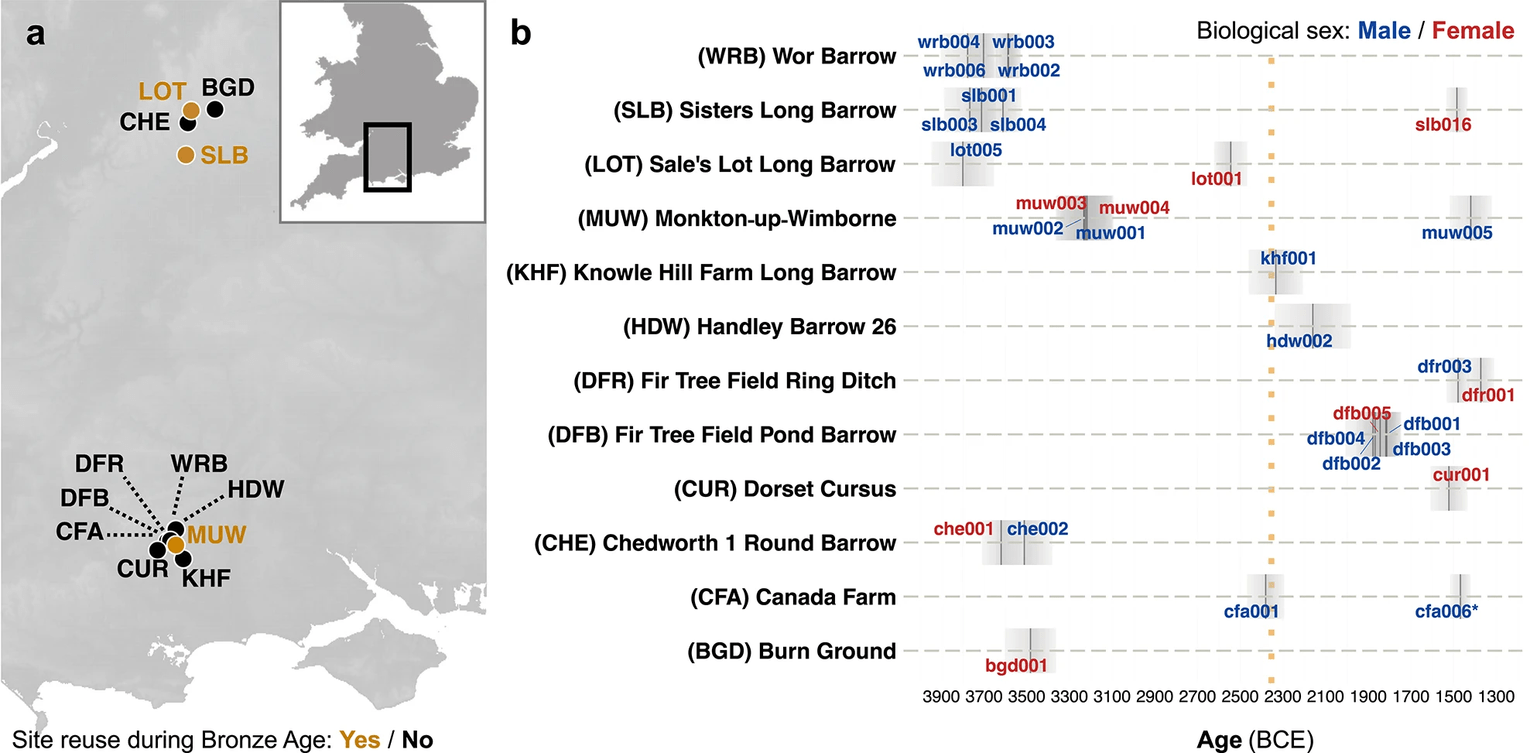
Diachronic reuse of Neolithic burial monuments by Bronze Age newcomers in Southwestern Britain
A new paper, co-authored by Nikola Vuković, Carolina Bernhardsson and Mattias Jakobsson, has recently been published in Scientific Reports:Vuković, N., Bernhardsson, C., Edlund, H., Delbarre, G., Smith, M., Darvill, T., Green, M., Endicott, P. & & Jakobsson, M. (2026). Diachronic reuse of Neolithic burial monuments by Bronze Age newcomers in Southwestern Britain. Scientific Reports, 16(1), 26819. DOI: https://doi.org/10.1038/s41598-026-66094-z…
-
Genetic relatedness mattered in the co-burial ritual of Neolithic hunter–gatherers
Mattila, T. M., Fraser, M., Koelman, J., Krzewińska, M., Ivarsson-Aalders, M., Götherström, A., Jakobsson, M., Storå, J., Günther, T., Wallin, P. & Malmström, H. (2026). Genetic relatedness mattered in the co-burial ritual of Neolithic hunter–gatherers. Proceedings of the Royal Society B: Biological Sciences, 293(2065). DOI: https://doi.org/10.1098/rspb.2025.0813 Abstract Kin relations among past societies can offer valuable information about…
-
Repeated plague infections across six generations of Neolithic Farmers
Magdalena, Mattias and Helena are contributors to the paper: Seersholm, F. V., Sjögren, K. G., Koelman, J., Blank, M., Svensson, E. M., Staring, J., … & Sikora, M. (2024). Repeated plague infections across six generations of Neolithic Farmers. Nature, 632(8023), 114-121. Abstract In the period between 5,300 and 4,900 calibrated years before present (cal. bp), populations across large parts of…
-
Identification of microbial pathogens in Neolithic Scandinavian humans
Bergfeldt, N., Kırdök, E., Oskolkov, N., Mirabello, C., Unneberg, P., Malmström, H., … & Götherström, A. (2024). Identification of microbial pathogens in Neolithic Scandinavian humans. Scientific Reports, 14(1), 5630. https://doi.org/10.1038/s41598-024-56096-0 Abstract With the Neolithic transition, human lifestyle shifted from hunting and gathering to farming. This change altered subsistence patterns, cultural expression, and population structures as shown by…
-

Northwest African Neolithic initiated by migrants from Iberia and Levant
A new article by Luciana Simões and others from the Jakobsson Lab is published in Nature. Abstract In northwestern Africa, lifestyle transitioned from foraging to food production around 7,400 years ago but what sparked that change remains unclear. Archaeological data support conflicting views: (1) that migrant European Neolithic farmers brought the new way of life to…
-
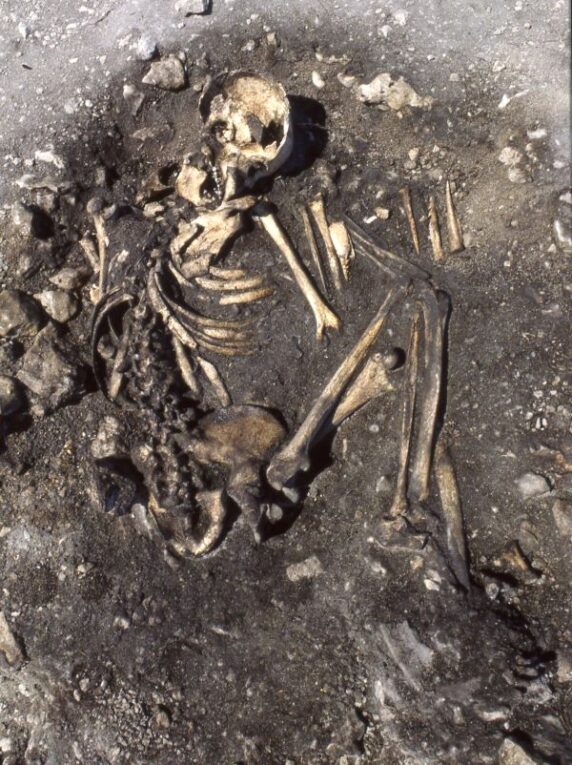
The Neolithic Pitted Ware culture foragers were culturally but not genetically influenced by the Battle Axe culture herders
A study by Coutinho et al. (2020) combines archaeological and genetic information to understand better Battle Axe cultural influences discovered in graves of the Pitted Ware culture. The genomic data show that all individuals belonged to one genetic population—a population associated with the Pitted Ware culture—irrespective of the burial style. The authors conclude that the…