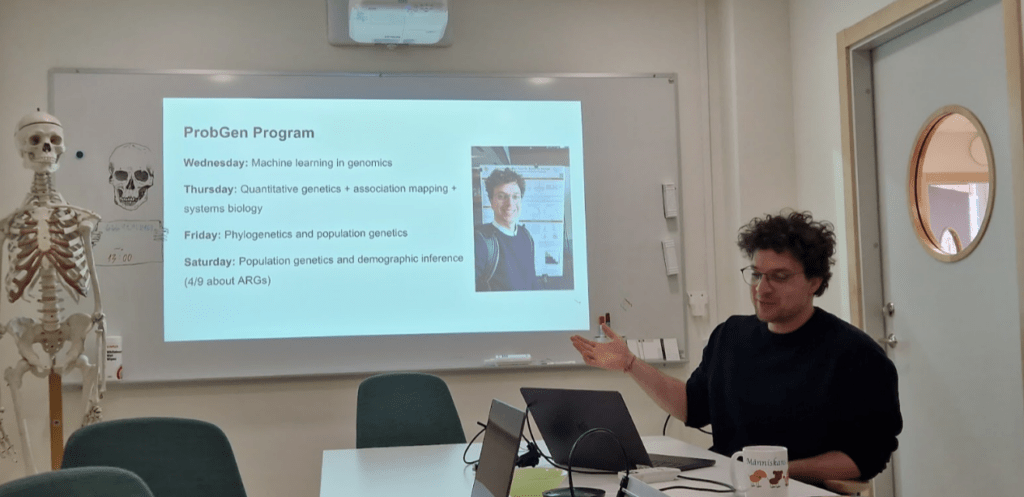
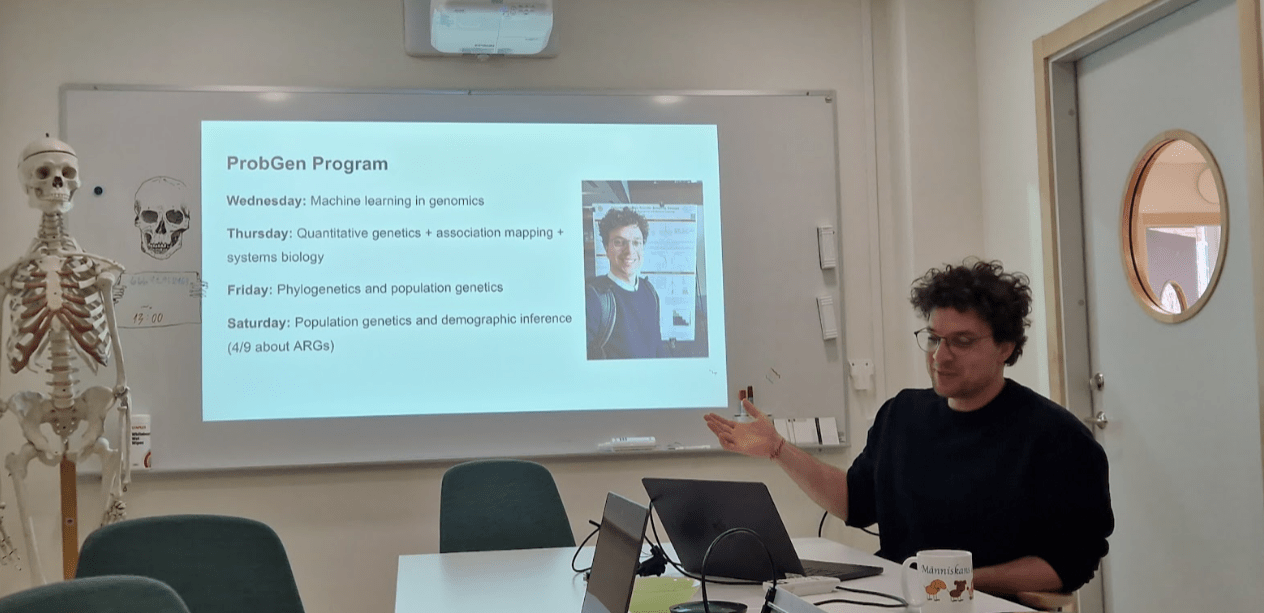
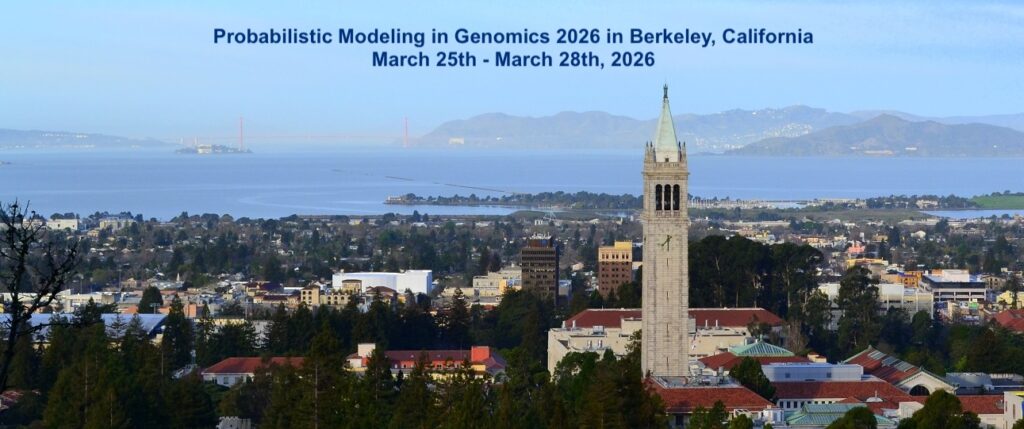
Mark Chernyshev attended the Probabilistic Modelling in Genomics conference in Berkeley, California, 25-28 March 2026 (ProbGen2026). The conference attracted around 1000 participants, and approximately 300 posters were displayed and discussed.
Mark presented some of his research in the poster: Detecting Sapiens-Specific Selective Sweeps by Leveraging Deep Divergence and Machine Learning.
Abstract
Identifying the selective pressures specific to the Homo sapiens lineage is difficult because sweep signals erode over relevant time scales. Previous methods used archaic genomes to detect extended lineage sorting (Peyrégne et al. 2017) or haplotype inconsistency between modern humans and archaics (Racimo et al. 2016), but neither directly targets the sapiens-specific branch. Here we leverage the deepest divergence within modern humans, using ancient southern Africans as unadmixed representatives of the Khoe-San population branch (Jakobsson et al. 2026), whose ancestors diverged from all other modern humans ~300kya, to define a branch-length statistic that specifically targets sapiens evolution, incorporating all five published high-coverage archaic genomes. We couple this statistic with a machine learning approach trained using evolutionary simulators, enabling detection of candidate sweep regions.