Category: Publications
-
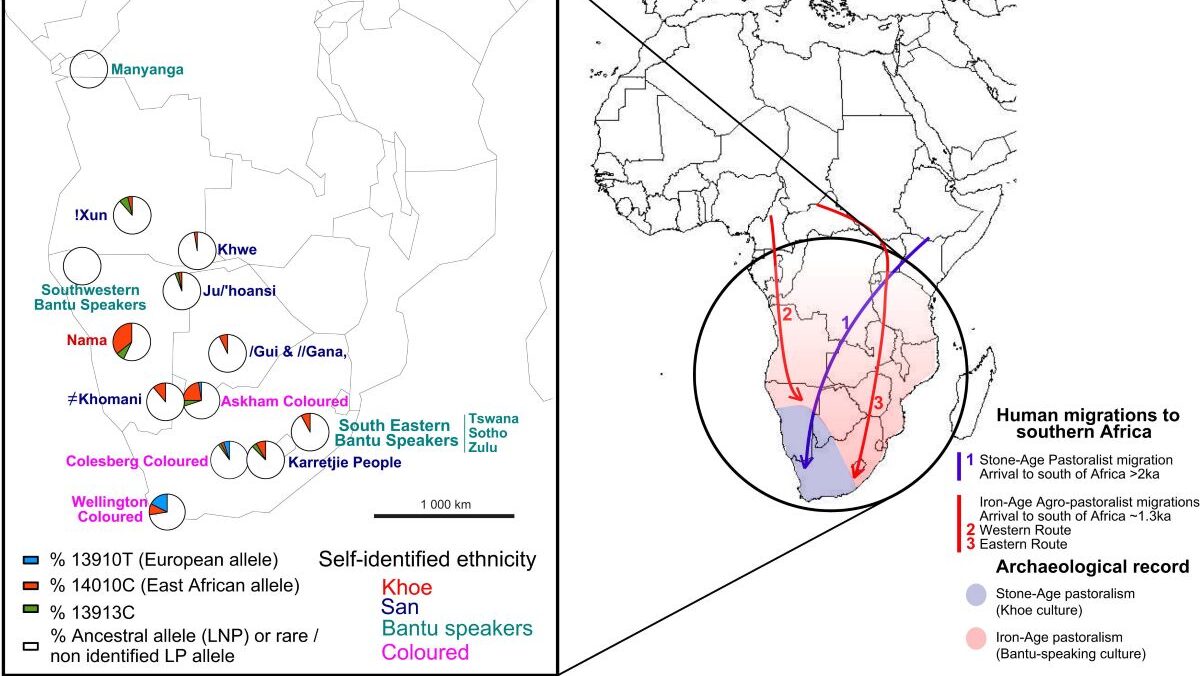
Lactase Persistence Alleles Reveal Partial East African Ancestry of Southern African Khoe Pastoralists
In a new study Breton et al. (2014) show how lactase persistence variants tell the story about the ancestry of the Khoe people in southern Africa. Highlights Related content Lactase persistence alleles reveal ancestry of southern African Khoe pastoralists
-

Separating ancient DNA from modern day contamination
Our paper “Separating endogenous ancient DNA from modern day contamination in a Siberian Neandertal” by Skoglund et al. (2014) was published in the early edition of PNAS. Significance Strict laboratory precautions against present day human DNA contamination are standard in ancient DNA studies, but contamination is already present inside many ancient human fossils from previous…
-

Dual ancestry of Native Americans
Our collaborative paper “Upper Palaeolithic Siberian genome reveals dual ancestry of Native Americans” was published online by Nature. Pontus Skoglund is the second co-author. Abstract The origins of the First Americans remain contentious. Although Native Americans seem to be genetically most closely related to east Asians1,2,3, there is no consensus with regard to which specific…
-
Sex identification of ancient remains
July 17, 2013. Our paper by Skoglund et al. (2013) on “Accurate sex identification of ancient human remains using DNA shotgun sequencing” was published by the Journal of Archaeological Science and highlighted by Nature. Highlights Abstract Accurate identification of the biological sex of ancient remains is vital for critically testing hypotheses about social structure in…
-

Investigation of population size changes rests on validating the demographic model
Our review-paper Lucie Gattepaile et al. 2013. Inferring population size changes with sequence and SNP data: lessons from human bottlenecks was published by Heredity. Abstract Reconstructing historical variation of population size from sequence and single-nucleotide polymorphism (SNP) data is valuable for understanding the evolutionary history of species. Changes in the population size of humans have…
-

The Relationship Between FST and the Frequency of the Most Frequent Allele
A new paper was published (and highlighted) in Genetics. Jakobssen et al. 2013. The relationship between FST and the frequency of the most frequent allele. Genetics, vol. 193, issue 2. Abstract FST is frequently used as a summary of genetic differentiation among groups. It has been suggested that FST depends on the allele frequencies at a locus, as it…