
Media coverage
2025
Homo sapiens-specific evolution unveiled by ancient southern African genomes, published in Nature

Jakobsson, M., Bernhardsson, C., McKenna, J., Hollfelder, N., Vicente, M., Edlund, H., Coutinho, A., Sjödin, P., Brink, J., Zipfel, B., Malmström, H., Lombard, M. & Schlebusch, C. (2025). Homo sapiens-specific evolution unveiled by ancient southern African genomes. Nature. https://doi.org/10.1038/s41586-025-09811-4
In the media:
Science News: Ancient Southern Africans took genetic evolution in a new direction
The Conversation: Becoming human in southern Africa: what ancient hunter-gatherer genomes reveal
Phys Org: https://phys.org/visualstories/2025-12-thousand-year-genomes-southern-africa.amp
Ground News (SA): Ancient Genomes From Southern Africa Reveal Distinct Human Lineage
Indian Defence Review: Ancient African Populations Were Isolated for 100,000 Years—And Their Genetics Are Completely Different
Popular Archaeology: Becoming human in southern Africa: What ancient hunter-gatherer genomes reveal
Discover Magazine: Ancient Genomes Expose 200,000 Years of Human Isolation in Southern Africa
Aventuras na História: Primeiros humanos evoluíram isolados no sul da África por quase 100 mil anos
Technology Networks: Ancient DNA Reveals Deep Roots of Humans in Southern Africa
Sverige Radio: Nya DNA-spår: mänsklighetens ursprung kan ha tolkats fel
Online FOCUS: Neue Studie offenbart: 100.000 Jahre Isolation prägten die Menschheit
The Times of India: Human evolution mystery unlocked: How 100,000 years of isolation in southern Africa revealed hidden secrets of ancient DNA and our evolutionary history
Stuttgarter Zeitung: Wiege der Menschheit: Ist der Mensch in Südafrika entstanden?
Frankenpost: Ist der moderne Mensch in Südafrika entstanden?
Archaeology News, online magazine: Ancient humans lived in isolation in southern Africa for nearly 100,000 years, new study shows
ABC: Sudáfrica, la ‘cuna olvidada’: hallan el ADN que cambió la historia de la Humanidad
Interia: Izolowali się przez 200 tys. lat. Naukowcy odkryli kluczowe mutacje w ich DNA
Earth.com: Lost lineage of early humans in Africa rewrites our origin story
Daily Neuron: Secrets in Ancient Human DNA Reveal a Lost Branch of Humanity

2024
Stone Age Hunter-Gatherers Avoided Inbreeding By Exchanging Women Between Tribes, Study Finds!, The Times of India
The Simões et al. (2024) article on exogamic practices of hunter-gatherers, published in PNAS, Anthropology appeared in some media outlets.
- The Times of India: Stone Age Hunter-Gatherers Avoided Inbreeding By Exchanging Women Between Tribes, Study Finds!
- LiveScience.com: Europe’s last hunter-gatherers had sophisticated societies that helped them avoid inbreeding
- IFLScience.com: How Did Stone Age Hunter-Gatherers Avoid Inbreeding?
- Varldenshistoria.se: Stenåldersmigranter utplånade norra Europas jägare och samlare
- Illustrerad vetenskap: Stenåldersmänniskor hade strategier för att undvika inavel
- Phys.org: Genetic study suggests a Stone Age strategy for avoiding inbreeding
2019
Mysterious ‘Battle Axe Culture’ reveals its secrets thanks to DNA discovery, Fox News

Our study on the Battle Axe Culture, presented in the research paper by Malmström et al. 2019. The genomic ancestry of the Scandinavian Battle Axe Culture people and their relation to the broader Corded Ware horizon was featured in the Fox News.
These Megalithic Tombs Contain the Remains of More Than 10 Generations of Stone Age Europeans, DNA Analysis Reveals, Newsweek

2017
Happy 350,000th birthday: Study pushes back Homo sapiens origins, Reuters

Our study, Southern African ancient genomes estimate modern human divergence to 350,000 to 260,000 years ago, published in Science by Carina Schlebusch and others (2017), received ample media attention.
Some of the media reports are listed below:
Some of the media reports:
in English:
Other newspapers that have picked up our study included: The Washington Post, NBC, ABC News, The New York Times, The Japan Times
in Swedish:
- Sverige Radio (including a short podcast)
- Friatider
In Russian:
In German:
Viking warrior discovered in Sweden was a woman, researchers confirm, The Independent

The international press picked up our 2017 study (“A female Viking warrior confirmed by genomics”) that uncovered a high-ranking Viking warrior to be a woman. The study created excitement all over the world reflected in a long list of reports published by media.
Some of the media reports:
in English
- New York Times
- Science
- The Guardian
- Newsweek
- CNN
- Washington Post
- National Geographic
- The Independent
- Forbes
- Science alert
- New York Post
- True Viral News
- Newshub
- MSN New Zealand
- Ancient Origins
- Truth or Not
- U.S. News
- ScienceNewsline
- F3News
- The Mail On Sunday
- Signs of the Times
- Science Blog
- Past Horizons
- Raw Story
- International Business Times
- Laboratory Equipment
- Follownews
- Archaeology Magazine
- Mail Online UK
- App.ViralNewsChart.com
- Russia Today
- PhysOrg.com
- The Local Sweden
De var de första svenskarna, SVT

Our work on the settlement of ancient Sweden was broadcast by the Swedish TV as part of the documentary series “Vetenskapens Värld” (season 26, episode 17 – in Swedish).
The findings were also presented in the SVT Nyheter De var de första svenskarna (2017) and Möt de första svenskarna (both in Swedish).
In 2019, a documentary program was broadcast on this particular research:
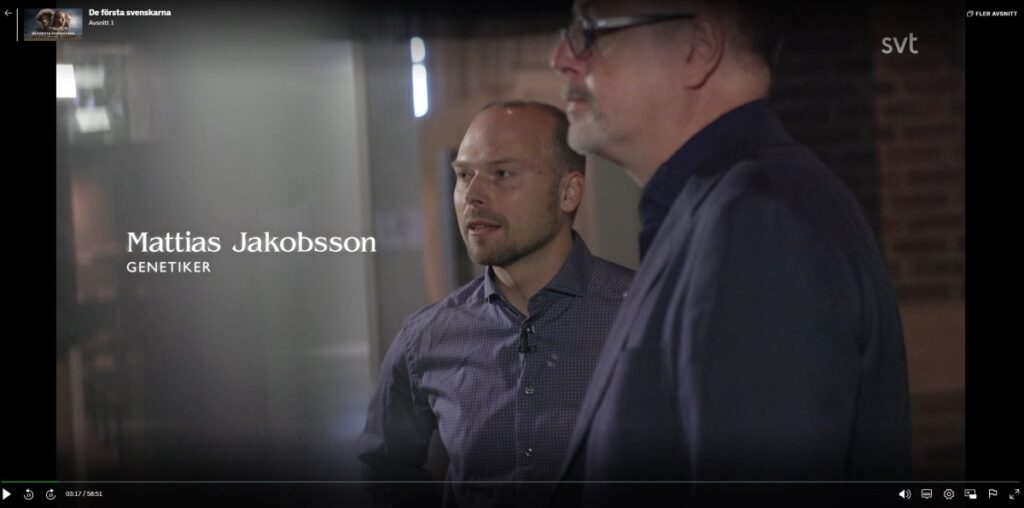
There’s no such thing as a ‘pure’ European—or anyone else, Science News

The Ann Gibbons’ article in Science News “There’s no such thing as a ‘pure’ European—or anyone else” (based on the interview with Mattias Jakobsson, among others) dives into diversity and migrations.
16 May 2017
Thousands of horsemen may have swept into Bronze Age Europe, transforming the local population, Science News
Europeans may be descendants of a massive migration of men from the Russian steppe.
The migration wave into Neolithic Europe was sex-biased as described in our paper: “Ancient X chromosomes reveal contrasting sex bias in Neolithic and Bronze Age Eurasian migrations.”
Some of the media reports:
- Science (21.02.2017)
- NZZ (Neue Zuericher Zeitung, 23.02.2017)
- Sverige Radio SR (22.02.2017)
- UNT (Så spreds jordbruket till Europa; 21.02.2017)
2016
Jakobsson Lab research a subject for a series of popular science reports in the Swedish radio

- Ny dna-analys: De tog jordbruket till Europa (Sverige Radio, SR, 05.08.2016)
Based on the paper: Gülsah Merve Kilinc et al. The Demographic Development of the First Farmers in Anatolia. Current Biology, 2016. - DNA-jakten som kom in i värmen (Sverige Radio, SR, 20.10.2015)
- Basker har samma ursprung som andra européer (Sverige Radio, SR, 10.09.2015)
Reference article: Günther et al: “Ancient genomes link early farmers from Atapuerca in Spain to modern-day Basques”, PNAS 2015. - Avlägsen rest rustar tibetaner (Sverige Radio, SR, 03.07.2014)
Reference paper: Huerta-Sánchez E. et al, Altitude adaptation in Tibetans caused by introgression of Denisovan-like DNA, Nature 3 juli 2014.
Så spreds jordbruket till Europa, UNT

The local newspaper reported on the paper, “The Demographic Development of the First Farmers in Anatolia”
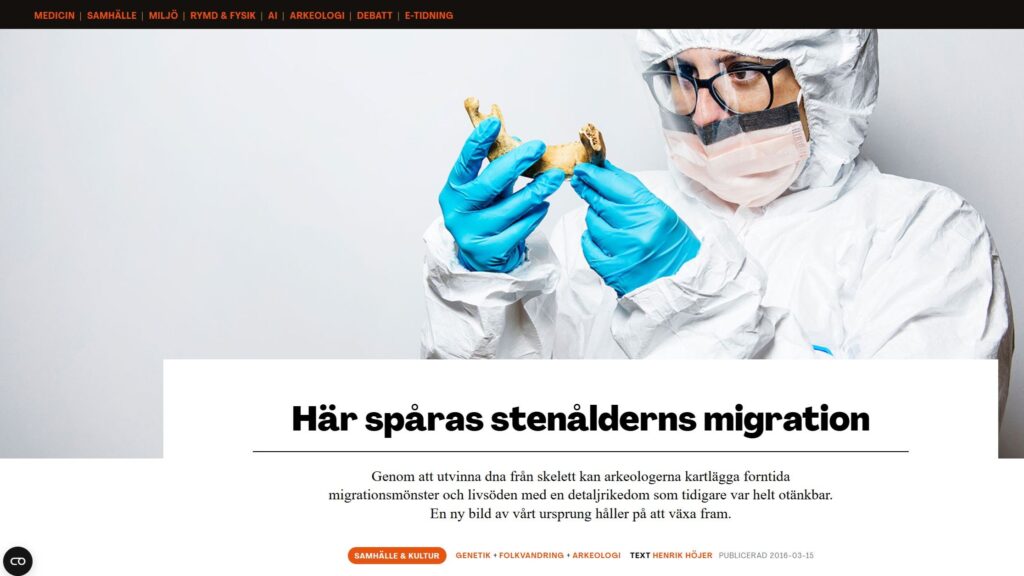
Här spåras stenålderns migration, Forskning & Framsteg
15 Mar 2016

By extracting DNA from skeletons, archaeologists can map ancient migration patterns and life destinies with a wealth of detail that was previously completely unimaginable. A new picture of our origins is emerging.
An article explaining and summarizing our research was published in Forskning & Framsteg, 15 Mar 2016 (in Swedish)
2015
Ancient DNA cracks puzzle of Basque origins, BBC News

Our 2015 paper “Ancient genomes link early farmers from Atapuerca in Spain to modern-day Basques” was picked by the British press.
Some of the media reports:
Uppsala University Podcasts – #8 Mattias Jakobsson

11 Nov 2015
Uppsala University presented Mattias Jakobsson and his research in one of the podcasts (in Swedish)
2012
African neighbours divided by their genes, Nature

Complex African history described in the 2012 Science paper “Genomic variation in seven Khoe-San groups reveals adaptation and complex African history” sparked the interest of media outlets.
Some of the media reports:
- CBS News
- Science News
- Nature
- Science daily
- Spiegel (in German)
- AAAS
- Swedish public television (SVT) (in Swedish)
- Swedish radio (SR1, SR2) (in Swedish)
- Uppsala Nya Tidning (in Swedish)
- Dagens Nyheter (in Swedish)
Farming ‘spread by migrant wave’, BBC News
The 2012 Science paper: “Origins and Genetic Legacy of Neolithic Farmers and Hunter-Gatherers in Europe” appears in several media outlets.
Some of the media reports:
- BBC News
- Dagens Nyheter (in Swedish)
- Sveriges Radio (1, 2) (in Swedish)
- Ny Teknik (in Swedish)
- Spiegel Online (in German)
- Der Standard (in German)
- Focus Online (in German)
- Le Figaro (in French)
- Los Angeles Times
- The Wall Street Journal
- NPR blog
- CNN KETK
- The Guardian
- La Repubblica (in Italian)
- Uppsala Nya Tidning (TV interview with Dr. Sugden, and print article) (in Swedish)
Genes shed light on spread of agriculture in Stone Age Europe
One of the most debated developments in human history is the transition from hunter-gatherer to agricultural societies. The Swedish-Danish research team presents the genetic findings which show that agriculture spread to Northern Europe via migration from Southern Europe.
An interview with Mattias Jakobsson, Department of Ecology and Genetics, Evolutionary Biology, Uppsala University. 26 Apr 2012