Category: News
-
Mariam receives funds to work on the Zdansky collection
Mariam is a successful awardee of a Uppsala University R Sernanders stipendiestiftelse scholarship (https://uaf.se/en/find-scholarships/our-foundations/r-sernanders-stipendiestiftelse/). The goal to directly advance the Foundation’s objectives in Quaternary geology and the history of fauna will be achieved by utilising soil genetics to analyse the sedimentary matrix of the Zdansky collection. Congratulations, Mariam!
-
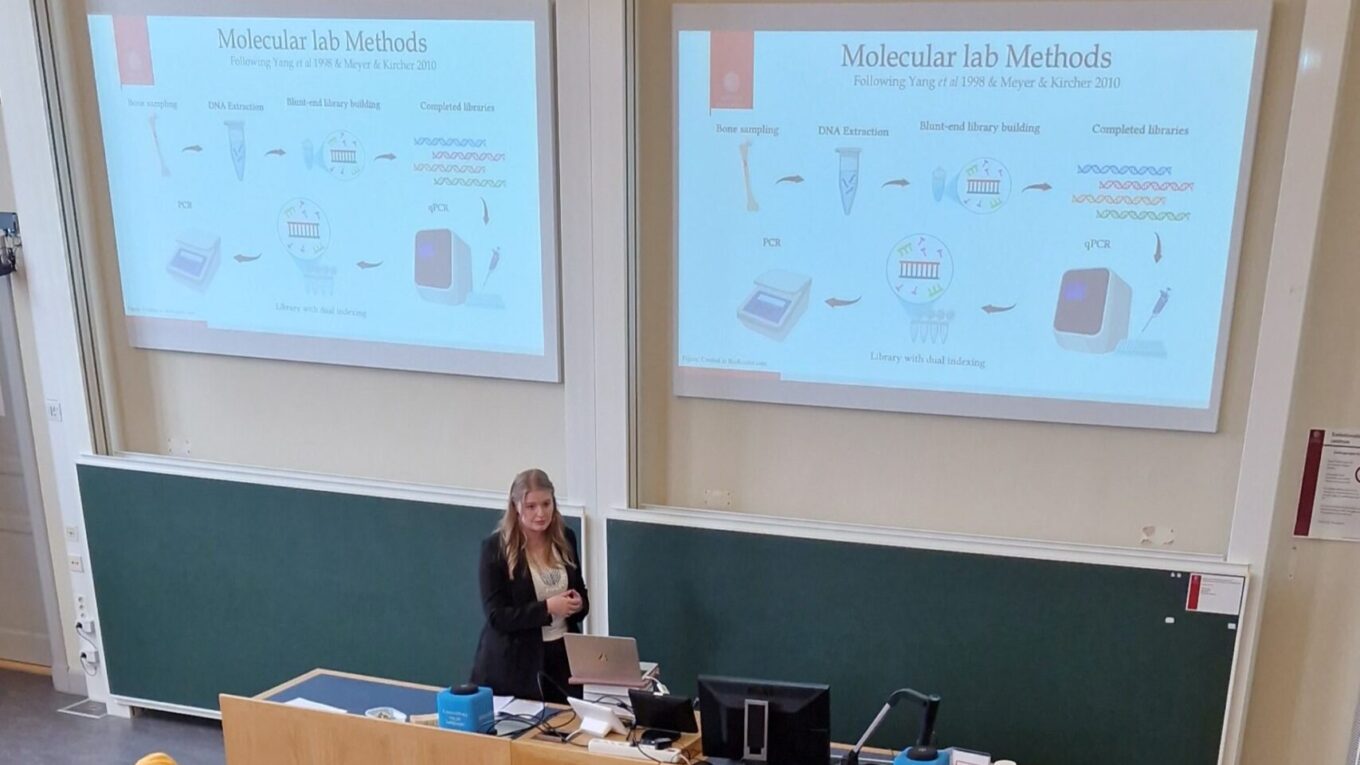
Louise successfully defends her Master’s thesis
Louise Olsson has completed her Master’s degree programme in biology, and successfully defended her thesis, entitled Genomic History of Northwestern Africa since the Iron Age, on Tuesday, 2 June. We all join the supervisor, Luciana Simões, in congratulations! The project summary can be found in another news item:
-
Lydia Furness joins the lab as a postdoctoral researcher in interdisciplinary genetics
“My research background lies at the intersection of archaeology, evolutionary anthropology, and biomolecular science. I trained initially as an archaeologist at the University of Liverpool, specialising in archaeological science and early human evolution, which provided a strong foundation in archaeological practice, material analysis, and the ethical dimensions of working with human remains and cultural heritage.”…
-

Surprising discovery in prehistoric DNA – traced to our kidneys
Latest research results from Mattias Jakobsson and his colleagues at the Human Evolution Program were featured on local TV (18 Apr 2026). By examining DNA from thousands of years-old bone fragments, researchers have found genetic changes that were present in prehistoric humans – and in us today. The researchers also made a surprising discovery: several…
-
Mark Chernyshev invited to attend 75th Lindau Nobel Laureate Meeting
“I’ve always believed that transformative research happens at the intersection of fields, so I am particularly thrilled to announce I have been selected to attend the interdisciplinary 75th Lindau Nobel Laureate Meeting!I’m looking forward to this rare opportunity to exchange ideas with young scientists and laureates across all Nobel disciplines.” This interdisciplinary event will take…
-
Meet Tan Xujie, a new junior research trainee in the Lab
Tan Xujie has just started research training in the Jakobsson Lab. For the next 4 months, he will work with Per Sjödin to examine how mutation spectra (which types of mutations are most common) vary across genomes. More specifically, how much they differ between modern humans, Neanderthals and Denisovans. Welcome to the group, Tan!