Tag: human past
-
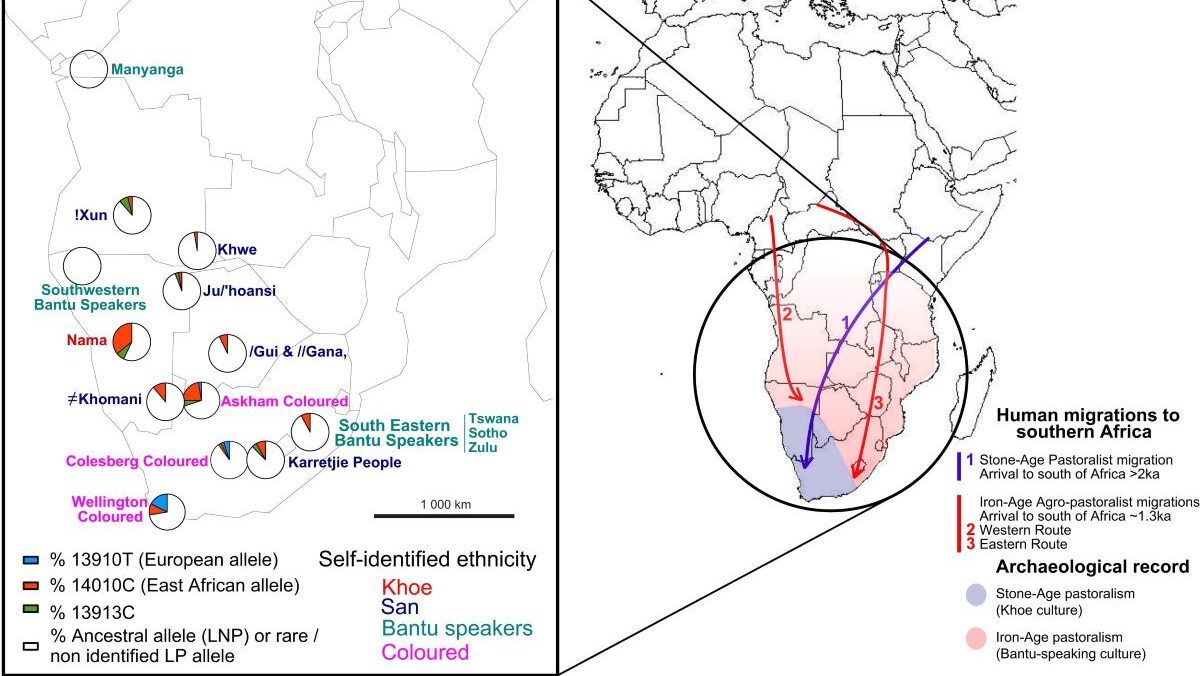
Lactase Persistence Alleles Reveal Partial East African Ancestry of Southern African Khoe Pastoralists
In a new study Breton et al. (2014) show how lactase persistence variants tell the story about the ancestry of the Khoe people in southern Africa. Highlights Related content Lactase persistence alleles reveal ancestry of southern African Khoe pastoralists
-

Separating ancient DNA from modern day contamination
Our paper “Separating endogenous ancient DNA from modern day contamination in a Siberian Neandertal” by Skoglund et al. (2014) was published in the early edition of PNAS. Significance Strict laboratory precautions against present day human DNA contamination are standard in ancient DNA studies, but contamination is already present inside many ancient human fossils from previous…
-

VR Grant for Distinguished Young Researchers
December 10, 2013. The Swedish Research Council’s “Grant for Distinguished Young Researchers” of 18 million SEK is awarded to Mattias Jakobsson. Congratulations!
-

Dual ancestry of Native Americans
Our collaborative paper “Upper Palaeolithic Siberian genome reveals dual ancestry of Native Americans” was published online by Nature. Pontus Skoglund is the second co-author. Abstract The origins of the First Americans remain contentious. Although Native Americans seem to be genetically most closely related to east Asians1,2,3, there is no consensus with regard to which specific…
-

The Atlas of ancient human genomes in Sweden
Riksbankens (the Swedish Central Bank) Jubileumsfond (RJ) granted 35.4 million SEK to our program “The Atlas of ancient human genomes in Sweden”. This is a collaborative program together with Anders Götherström and Jan Storå at Stockholm University.
-
Sex identification of ancient remains
July 17, 2013. Our paper by Skoglund et al. (2013) on “Accurate sex identification of ancient human remains using DNA shotgun sequencing” was published by the Journal of Archaeological Science and highlighted by Nature. Highlights Abstract Accurate identification of the biological sex of ancient remains is vital for critically testing hypotheses about social structure in…